On
the last weekend of November, 2012, South Korea’s Rural-20 project gave over 20
foreign students a glimpse of rural life in Korea and its history in Gurim
village. The tour created bonds stretching all over the world and left us
international students in awe of the beauty of rural Korea.
On
the last weekend of November, 2012, South Korea’s Rural-20 project gave over 20
foreign students a glimpse of rural life in Korea and its history in Gurim
village. The tour created bonds stretching all over the world and left us
international students in awe of the beauty of rural Korea.
During a two-day, one-night tour to Gurim
village located in Yeongam country in the South Jeolla province, more than 20
foreign students were given a unique chance to experience rural life of Korea
as it looks today, as well as an enlightening tour on the history of Gurim
village and how developments there propelled the history of Korea as a whole. This
tourism course is a part of the Rural-20 Project developed by the South Korean
Ministry of Food, Agriculture, Forestry and Fisheries in order to portray the
marvels of rural villages to both Koreans and the rest of the world. Gurim
village is one of around 20 select villages that can boast intact natural
environments and traditions.
So why Gurim village? With a history dating
back about 2200 years, the village certainly has exerted its influence
throughout time both on Korea and adjacent countries. The relics of Doctor
Wangin, who was a legendary scholar and essential to Japanese ancient culture,
can today be found in Gurim village as well as the Yeongam Ceramic Museum which
exhibits excavated ceramics that were once upon a time created in one of the
ten firing stations in the area.
Our tour began in the best possible manner when
I entered the bus, that would take us through Korea on a 4-hour ride, and
noticed that the seats were much up to par with any business class airplane
seats (this is strictly not speaking from experience since I have never been
one of the lucky ones to get a free upgrade from economy to business class
while flying…^^). Accompanying us was a tour guide whose mission was to
translate all the information given by the local guides from Korean to English.
During my time here in Korea this is the first time I have seen a tour where
someone’s duty actually is to translate, which, safe to say, immensely
contributed to my and other’s understanding of the local sites.

Upon arrival to Gurim village we were
presented with an open buffet of bibimbap where we got to select and mix rice,
a wide array of locally produced and picked vegetables, meat, red chili paste,
sesame oil (and the list goes on…) in a manner that the locals named ‘Freestyle
Bibimbap’ (probably named on the spot!)

After lunch it was due time to get married!
Given Christianity’s wide spread in Korea there are today many weddings held in
churches or in an originally ‘Western’ manner in wedding halls. However, still
today there is a big part of the population who additionally or exclusively get
wed in a more traditional, Korean fashion. In connection to the wedding experience
we also got to try Korean traditional gowns known as hanbok (literally translated to ‘Korean clothing’). Today, these
dresses that usually come in vibrant colors are mostly worn on special or
formal occasions. The female version consists of a blouse shirt or jacket and a
wrap-around skirt. Men’s hanbok
consists of a shirt or jacket and pants which are characterized by its huge
size to to make it ideal for the wearer to sit on the floor. Instructing the
students on how to wear this hanbok
and what etiquette to follow was a teacher or headmaster known as the hunjang. During the Goryeo and Joseon
dynasties of Korea there were private village schools called seodang were these teachers taught
primarily etiquette and literature to boys of 7-16 years of age. The teaching
method emphasized rote by endless repetition of literary passages and through
this a Korean idiom was born, namely ‘서당개 3년이면 풍월을 읊는다’ which freely translated means
that even a dog can learn to recite poetry if it stays near one of these seodang schools for three years. During
those days, corporal punishment was allowed, and our hunjang teacher looked mighty menacing strutting his wooden stick
and pointing with it while explaining how to wear the hanbok, but of course he was only putting on a show.


Following the wedding, were two students
who I hope are not regretting their decision were joined in holy matrimony, we
got to try our hand at Korean paper crafts known as
hanji. In much similar fashion to cooking shows were the chef
already has prepared the most intricate steps in advance, we were presented
with an adorable box made from thick, carton-like paper and were given the task
to adorn it. The teachers provided the ever-so necessary aid to someone like me
who might not have the deftest fingers around. The result, as you can see, was
not something to be ashamed of and makes for a good gift for family or loved
ones.


By this time some excess energy had been
built up in the bodies of some of the more athletic students after these
finicky paper crafts. What luck it was then that it was time to pound some rice
with a mallet! Korean rice cake is usually made from repeatedly pounding
steamed rice with a wooden mallet while adding water to prevent the rice cake
from sticking to the surface. It certainly is a sight to see two skilled people
co-operating to make finger licking delicious rice cake, but even an untrained
layperson as myself gave that rice a beat down to remember!
Are you hungry yet? Well, so were we, and
it was high time partake of the dinner served at the local restaurant. This
time around the table was set with an uncountable number of side dishes, rice
and soup as well as the icing on the cake on a Friday night, namely dongdongju. Dongdongju is traditional,
milky-looking liquor which is brewed from rice, yeast, (flour) and water. Our
table started out with three huge bowls of this locally brewed beverage but as
the hours passed the bowls increased to a total of three bowls divided among
four people. Safe to say it was an enjoyable night!
The evening continued at our lodging for
the night which consisted of a few traditional Korean houses where all 24 of us
were separated into smaller groups. The hosts were ever so caring and
hospitable that they even let 10 of us sleep in the house they live in
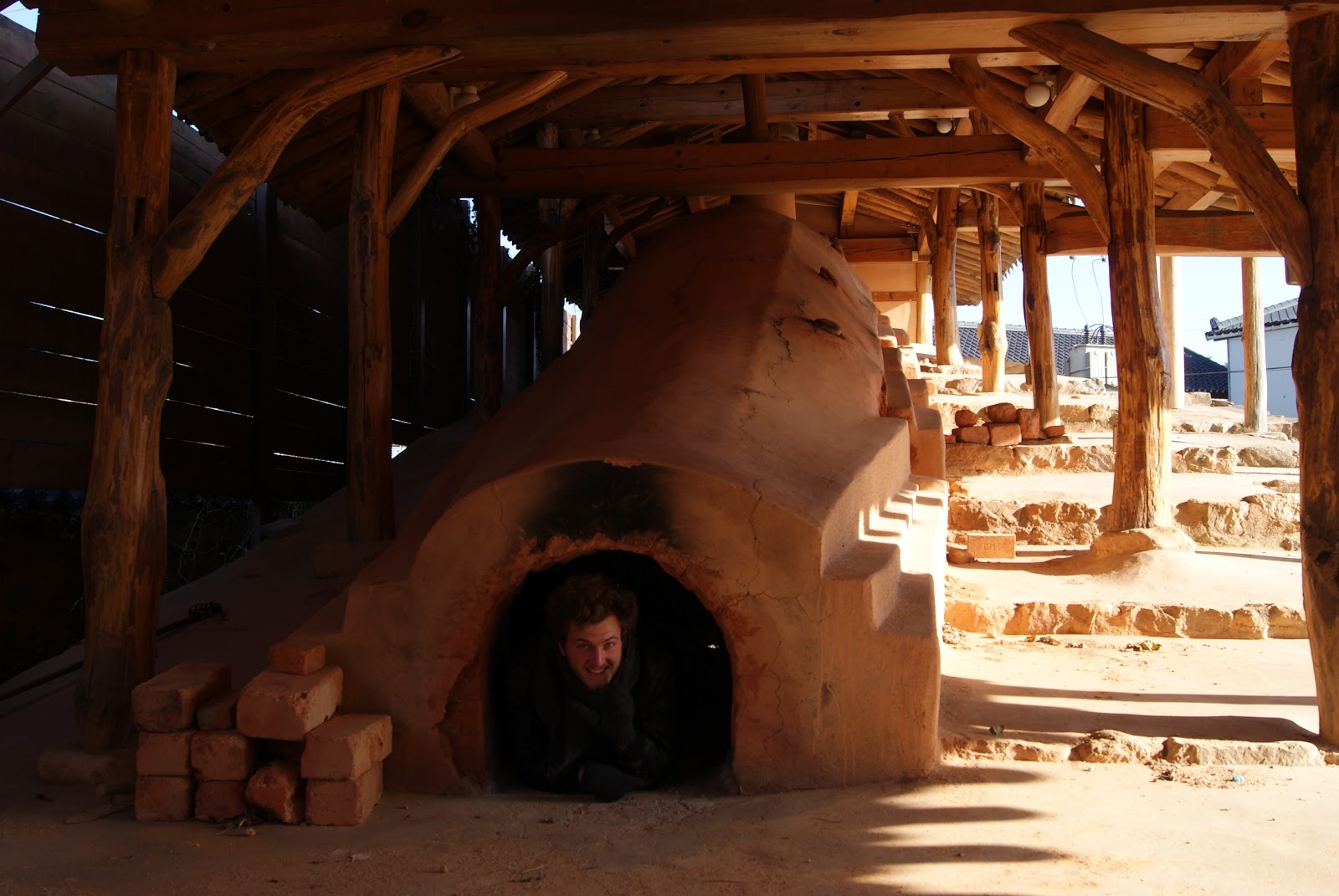
themselves. The houses were heated by so-called ondol heating which in the old days was utilized in Korean
traditional architecture to heat the floor via a wooden fire under the house.
The warm smoke travels through smoke passages, thus heating the floor from
underneath before finally going out through a chimney. More info about the
accommodation in Korean at http://ygurim.namdominbak.go.kr/


The following day was spent after having
breakfast by visiting the Wang-in Korean traditional paper craft gallery
directed by Suk-Sim Oh (more on Wang-in later in this post). Here an array of
lamps, pictures, sculptures, furniture (!) and other crafts all made from paper
were on display. Later we had the pleasure of visiting the Yeongam Ceramic
Museum where ceramics and kilns excavated from the area are being exhibited.
The most lasting image from the museum for me personally was the earthen
coffins within which late people were put before the whole coffin was buried
beneath the ground. Visitors can also have a go at making ceramics pieces
themselves or just buy professional pieces from the home of the first glazed
ceramics in Korea.


 Now, who might this Doctor Wangin that has
been mentioned sparsely throughout this text be? Well, we got to visit the
relics that were created to learn the spirit of Doctor Wangin and learned that
he was a great scholar who moved to Japan and had a big effect on the
development on culture in general in Japan, mainly so in the areas of arts,
crafts and music. This attraction stands in honor of his memory and
achievements and I refuse to spoil more here since I highly recommend you to
visit and experience it firsthand instead.
Now, who might this Doctor Wangin that has
been mentioned sparsely throughout this text be? Well, we got to visit the
relics that were created to learn the spirit of Doctor Wangin and learned that
he was a great scholar who moved to Japan and had a big effect on the
development on culture in general in Japan, mainly so in the areas of arts,
crafts and music. This attraction stands in honor of his memory and
achievements and I refuse to spoil more here since I highly recommend you to
visit and experience it firsthand instead.


The trip was rounded up in good fashion at
the Dogapsa temple which is located by Wolchul Mountain which attracts many
hikers. The temple itself was founded by the monk Doseonguksa and the area
includes many historic and cultural treasures. We got to walk 3 laps silently
around the statue in front of the main temple building to clear ourselves of
our sins (from a choice of 3, 7 or 106 laps!) Hosting a very picturesque nature
and buildings, the temple area is sure worth a visit.
While signing up for this tour experience I
had a few doubts and feared that I would dislike the rural area and start
missing Seoul in just a few hours. On the contrary, upon departing from Yeongam
towards Seoul, I felt that I could have easily stayed for quite some time
longer. I feel more enlightened about rural Korea and proud to have taken part
in something many urban Koreans never have. Well, now everyone has the chance
thanks to the South Korean Ministry of Food, Agriculture, Forestry and
Fisheries and their Rural-20 project. Tour packages come at the budget price
interval of 10.000 to 39.000 won and span from one to two day periods. To sign
up, visit http://www.rural20.kr/en/
(currently available in English, Korean, Japanese and Chinese) for deeper
information.


 There are many varieties of tteokguk and
ways to cook it. The broth in particular is a whole art in itself and there are
many secret methods. However, cooking it at home doesn’t need to be so hard as
to cook the broth by simmering meat for several hours. Instead you can make the
broth with a filter bag of myeolchi (dried anchovies) and some dashida powder
(beef stock powder). Now, the usual basic ingredients you put in are manduu
dumplings (if you have the time you can make the dumplings from scratch,
including the covers, or just buy the covers ready-made and make the stuffing
yourself or just buy the whole thing ready-made, either frozen, fresh or
refridgerated). In addition to the manduu you usually add rice cake, some
sliced beef or other meat and soy sauce. Once everything it starting to get
warm in the boiling broth, you can crack and add an egg or two straight into
the bowl during the last minutes or you can add pan-fried julienned egg on the
top. Other garnish you can add are sesame seeds, sliced spring onions and
seaweed.
There are many varieties of tteokguk and
ways to cook it. The broth in particular is a whole art in itself and there are
many secret methods. However, cooking it at home doesn’t need to be so hard as
to cook the broth by simmering meat for several hours. Instead you can make the
broth with a filter bag of myeolchi (dried anchovies) and some dashida powder
(beef stock powder). Now, the usual basic ingredients you put in are manduu
dumplings (if you have the time you can make the dumplings from scratch,
including the covers, or just buy the covers ready-made and make the stuffing
yourself or just buy the whole thing ready-made, either frozen, fresh or
refridgerated). In addition to the manduu you usually add rice cake, some
sliced beef or other meat and soy sauce. Once everything it starting to get
warm in the boiling broth, you can crack and add an egg or two straight into
the bowl during the last minutes or you can add pan-fried julienned egg on the
top. Other garnish you can add are sesame seeds, sliced spring onions and
seaweed.

 There are many varieties of tteokguk and
ways to cook it. The broth in particular is a whole art in itself and there are
many secret methods. However, cooking it at home doesn’t need to be so hard as
to cook the broth by simmering meat for several hours. Instead you can make the
broth with a filter bag of myeolchi (dried anchovies) and some dashida powder
(beef stock powder). Now, the usual basic ingredients you put in are manduu
dumplings (if you have the time you can make the dumplings from scratch,
including the covers, or just buy the covers ready-made and make the stuffing
yourself or just buy the whole thing ready-made, either frozen, fresh or
refridgerated). In addition to the manduu you usually add rice cake, some
sliced beef or other meat and soy sauce. Once everything it starting to get
warm in the boiling broth, you can crack and add an egg or two straight into
the bowl during the last minutes or you can add pan-fried julienned egg on the
top. Other garnish you can add are sesame seeds, sliced spring onions and
seaweed.
There are many varieties of tteokguk and
ways to cook it. The broth in particular is a whole art in itself and there are
many secret methods. However, cooking it at home doesn’t need to be so hard as
to cook the broth by simmering meat for several hours. Instead you can make the
broth with a filter bag of myeolchi (dried anchovies) and some dashida powder
(beef stock powder). Now, the usual basic ingredients you put in are manduu
dumplings (if you have the time you can make the dumplings from scratch,
including the covers, or just buy the covers ready-made and make the stuffing
yourself or just buy the whole thing ready-made, either frozen, fresh or
refridgerated). In addition to the manduu you usually add rice cake, some
sliced beef or other meat and soy sauce. Once everything it starting to get
warm in the boiling broth, you can crack and add an egg or two straight into
the bowl during the last minutes or you can add pan-fried julienned egg on the
top. Other garnish you can add are sesame seeds, sliced spring onions and
seaweed.